
Levi Dunn and Dominick Pelaia needed to find a mentor for their high school research project. The L&N STEM Academy students were building a model to perform materials prediction using data from microscopes.
Their teacher suggested they reach out to a member of the University of Tennessee engineering faculty. Dunn and Pelaia emailed Gerd Duscher, a professor in the Department of Materials Science and Engineering. They were a bit nervous if he would even respond.
Not only did Duscher reply, but he was so impressed with Dunn and Pelaia’s project that he hired them as paid interns for his lab group.
“I’m usually looking for people who are interested and naturally curious. That’s what really makes the difference, because Levi and Dominick are really very interested, very curious, and they have a lot of fun with this,” Duscher said. “They enjoy finding stuff out, and that’s what you want in a young scientist.”
Dunn and Pelaia’s research project involved integrating a large language model (LLM), like ChatGPT, directly into a room-sized scanning transmission electron microscope’s automation loop to characterize materials at the atomic level.
By embedding the LLM as an intelligent control agent, the system enables users to direct complex microscope operations using natural language. Instead of manually configuring dozens of parameters, a user can describe the desired experiment in words, and the system translates that intent into precise instrument actions.
Dunn and Pelaia were named the grand champions for their project at the Southern Appalachian Science and Engineering Fair hosted by Pre-college Research Excellence Programs at UT. The win qualified them for the Regeneron International Science and Engineering Fair (ISEF), a worldwide gathering of more than 1,700 young scientists, engineers, entrepreneurs, and inventors.
They presented their work at Regeneron ISEF from May 9-15 at the Phoenix Convention Center in Arizona and won fourth place in the Materials Science category. The finish came with a $600 prize.
“It was such an incredible experience, and I met so many interesting people from all over the world,” Pelaia said. “I was so honored to represent L&N STEM Academy and Tennessee on the global stage, and I hope we inspired other students to do the same.”
Valuable internship experience
Dunn and Pelaia’s high school research project coincided with work Duscher and his MSE colleagues were already doing at UT on making their remote-controlled microscope compatible with LLMs.
“They have background in large language models, and that’s what we needed. That was completely done on their own,” Duscher said. “Levi and Dominick did the work on the integration. We thought if they did a little bit then we would be good. But they did it all, so we were very happy.”
The framework established at UT introduces a fundamentally new paradigm for scientific instrumentation. The LLM-driven agent interprets experimental goals, adjusts microscope settings in real time, and interacts dynamically with the instrument’s control software. The result is a more flexible, adaptive, and accessible method for atomic-scale imaging.
The LLM agent at UT is powered by ISAAC Next Generation high-performance computing (HPC) resources through the Tennessee AI Initiative, with active support of the manufacturer of the microscope, Thermo Fisher Scientific.
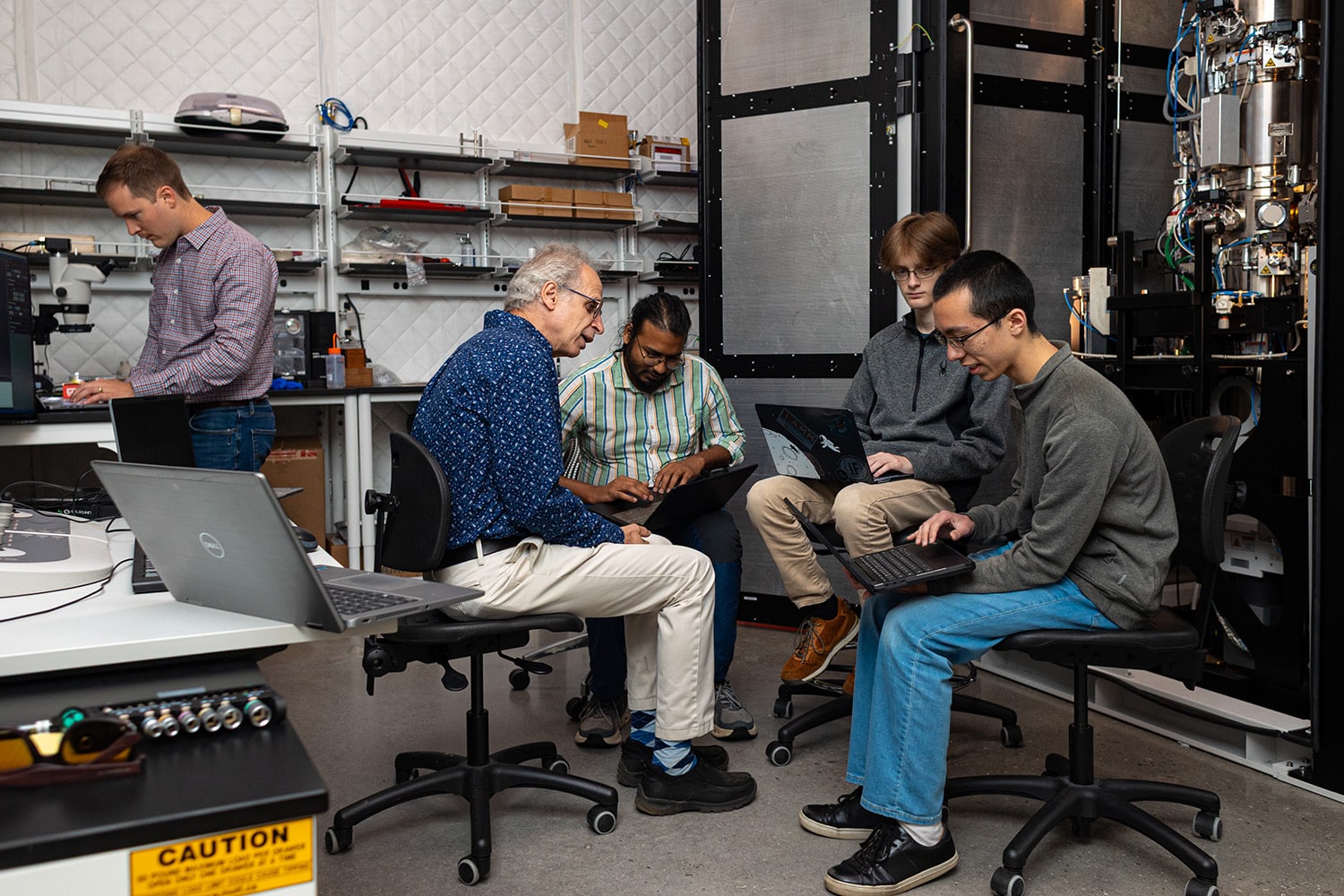
As interns, Dunn and Pelaia have worked with Duscher, MSE Weston Fulton Professor Sergei Kalinin, and MSE PhD students Austin Houston and Utkarsh Pratiush.
“It’s been invaluable to have them mentoring us. We couldn’t really have done our project without it,” Dunn said. “We have the supercomputer that we use at UT for running our model, and we couldn’t have done anything without that. We have the microscope, which we definitely couldn’t have done without UT.”
Significant steps forward
Dunn will be attending UT in the fall as a freshman MSE major. Pelaia is returning to L&N Stem Academy for his senior year. The award-winning research project combined their strengths. Dunn is good at materials science and Pelaia has an aptitude for computer science and coding.
Dunn and Pelaia never imagined their project would be a springboard to working so closely with Duscher’s group at their age. The lab group’s work represents a significant step toward intelligent scientific instruments capable of reasoning about experiments and responding in real time to help enhance the field of materials characterization and innovation.
“Materials are key to everything, whether it’s aerospace or bulletproof vests. Materials have a ton of applications,” Pelaia said. “Nanoparticles are super important, and this will dramatically accelerate the rate at which we develop new materials and analyze the properties of existing materials.”
Contact
Rhiannon Potkey ([email protected])