
Latest News
-
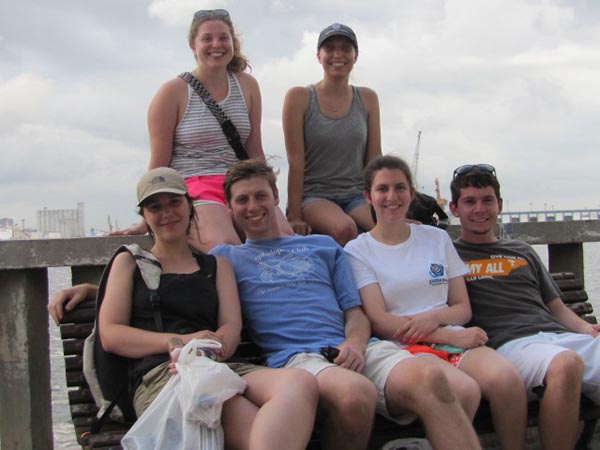
Trip Report: Alternative Summer Break in Cuba
Read Evalynn Borrego’s report on the Cuba trip » Read Aubrey Casey’s report on the Cuba trip » Read Brian Grim’s report on the Cuba trip » Read Reed Schneider’s report on the Cuba trip » Read Meghan Treece’s report on the Cuba trip » From May 11 – 17, 2016, the TCE sponsored a trip to Havana,…
-
Research Highlight: Ben Blalock
Professor of electrical engineering and computer science Ben Blalock recently collaborated with NASA and the Jet Propulsion Laboratory on a historical research project that is helping to allow the Mars rover “Curiosity” to explore that planet’s terrain. Blalock and team set out to design integrated circuits, or in this case, ‘quad op amp’ microchips, for…
-
Chris Cherry
Cherry has looked at behavioral and environmental aspects related to electric bikes, scooters, and larger electric vehicles in his research and has published articles related to the growth of electrical two-wheelers.
-
Research Highlight: Hans DeSmidt
His research interests include helicopter and rotor dynamics, active vibration control, structural health monitoring, rotocraft propulsion, and adaptive structures.
-
Research Highlight: Kivanc Ekici
Dr. Kivanc Ekici, an associate professor in UT’s Department of Mechanical, Aerospace, and Biomedical Engineering, is intent on making turbines less prone to failure and capable of wringing ever more energy from the wind. He believes new designs for turbine blades hold the key to those gains. A wind turbine idled by a blade failure…
-
Research Highlight: Zannatul Ferdous
Dr. Zannatul Ferdous, an assistant professor in the Department of Mechanical, Aerospace, and Biomedical Engineering, leads a research team addressing one of humanity’s biggest health issues. Cardiovascular diseases are the world’s number one cause of death, with some estimates indicating that as many as one-third of the planet’s deaths in a given year are attributable…
-
Research Highlight: Jason Hayward
Working with Oregon State University, Jason Hayward is working to improve the accuracy and reduce the cost of monitoring the massive amounts of plutonium that are housed in nuclear facilities. Hayward’s team hopes to use cosmic ray muons, a type of particle, to do this. “Cosmic ray muons are so highly penetrating that they have…
-
Research Highlight: Wei He
Wei He, a joint assistant professor in the Departments of Materials Science and Engineering and Mechanical, Aerospace and Biomedical Engineering, is carrying out exciting engineering research on materials-enabled interventions to tackle challenging medical problems. He’s doctorate is in chemistry, but her research has progressed from chemistry to engineering materials to biomedical science. She says that…
-
Research Highlight: Jeremy Holleman
Holleman is also teaming with some unlikely partners to investigate low-power integrated circuits for biomedical devices and other wireless sensing applications—bats.
-
Research Highlight: Ramki Kalyanaraman
In finding the right mix of materials, the UT-led team happened upon an entirely unexpected result—a magnetic material with extremely strong optical interactions that place it under consideration as a metamaterial, meaning a material with properties not found in nature.
Submit a Story
Do you have a story to share? Have you received a recent award? Are you going to be published soon?
Tennessee Engineer
Tennessee Engineer is published in the spring and fall by the University of Tennessee, Knoxville, Tickle College of Engineering for alumni, faculty, staff, and friends of the college.
Annual Report
The college’s annual report is published every year in the fall.