

Three new faculty members are joining the Department of Biomedical Engineering in the fall 2026 semester, bringing new expertise in bioimaging, biomaterials, and biomechanics.
Caigang Zhu, Lauren Pruett, and Weiyi Qian will contribute significantly to teaching and graduate education within the department. They are all doing high-level research with real-world applications that will have positive impacts on society.
“We are thrilled to welcome three outstanding new colleagues to our young department. Drs. Pruett, Qian, and Zhu bring exceptional expertise, innovative ideas, and a passion for discovery,” said BME Department Head Dacheng Ren. “They will strengthen our research and educational missions while helping prepare the next generation of biomedical engineers to address complex challenges. I look forward to the many contributions they will make to our biomedical engineering community.”
Caigang Zhu
Associate Professor
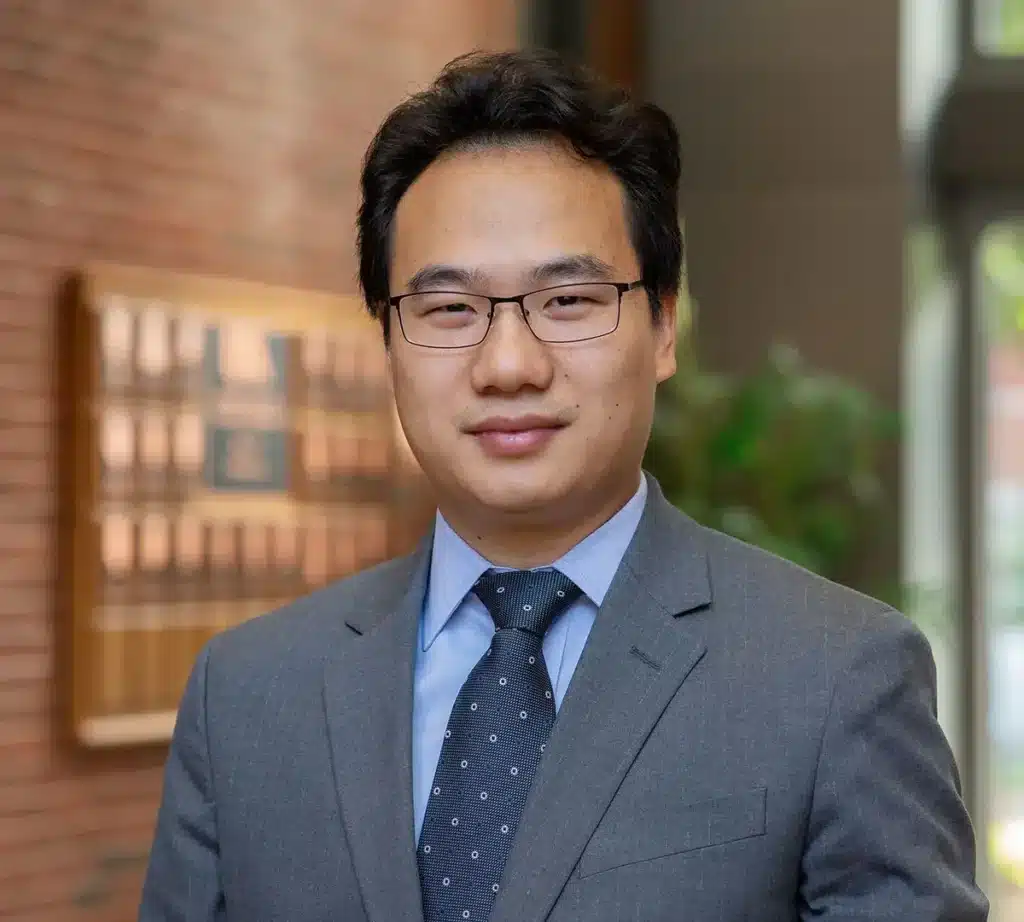
Zhu joins UT from the University of Kentucky, where he spent five years as an assistant professor and two years as an associate professor. Zhu earned his bachelor’s degree from Huazhong University of Science and Technology, China, and his PhD degree from Nanyang Technological University in Singapore, both in biomedical engineering. He then received his postdoctraining at Duke University. His current research is motivated by multidisciplinary applications of novel optical techniques in cancer research. The central focus of the group’s research is to develop optical spectroscopy and imaging tools for biomedical applications related to tumor metabolism, hypoxia, and angiogenesis. The research interests of his lab include vascular and metabolic imaging/spectroscopic techniques for studies of cancer biology and radiation therapeutics study.
“I’m thrilled to join UT’s BME department, which has a lot of potential and opportunities to grow in the future. I look forward to advancing research in biomedical optics and cancer therapeutics, while contributing to the education and success of our students at UT.”
Lauren Pruett
Assistant Professor

Pruett joins UT after completing her postdoctoral training at the Massachusetts Institute of Technology (MIT) in the Center for Gynepathology Research. She completed her PhD in biomedical engineering from the University of Virginia as an NIH F31 and NSF GRFP fellowship recipient. Her research focuses on the development of tissue-engineered models that replicate key features of human disease. By integrating synthetic hydrogels, microfluidics, and quantitative approaches, her lab will create vascularized models centered on women’s health applications, with broad applicability for investigating other vascular and inflammatory disorders.
“I’m excited to join the new biomedical engineering department at UT and help establish tissue engineering as a new research strength. I look forward to developing collaborations with clinical impact, particularly in women’s health, and mentoring and educating the next generation of scientists and engineers.”
Weiyi Qian
Assistant Professor

Qian joins the department after his postdoctoral training in developmental and cell biology at New York University Grossman School of Medicine. He won an NIH K99/R00 Pathway to Independence Award, which helps postdoctoral researchers complete mentored training and transition to independent faculty positions. Qian obtained his bachelor’s degree in materials physics from Wuhan University and completed his PhD in mechanical engineering at the NYU Tandon School of Engineering. His research has been at the interface of biology and engineering, focusing on understanding how mechanical and chemical signals work together to direct cells’ behaviors during normal development and disease progression. At UT, he will be using Danio rerio (zebrafish) as a model system and deploying a multi-disciplinary toolbox, including genetics, molecular biology, and biophysics, to understand the cellular, molecular, and physical mechanisms of how living tissues build functional sensory organs and the brain during embryonic development. This knowledge will help to understand what goes wrong in diseases, such as congenital birth defects, and develop therapeutic strategies.
“I look forward to working with the students and faculty at UT to push the limits of our understanding of embryonic development at the interface of biology and mechanics. I see exciting opportunities to tackle the challenges in this research field by bridging different disciplines across UT.”
Contact
Rhiannon Potkey ([email protected])