
undergrad programs
BS in Biomedical Engineering
As healthcare technologies advance and medicine becomes increasingly data-driven and personalized, the demand for biomedical engineers is growing worldwide. Our program cultivates the next generation of problem-solvers by providing a comprehensive foundation in engineering, biology, and design. Students in UT’s biomedical engineering program are equipped to improve lives through innovation—whether developing life-saving medical devices, advancing diagnostic tools, or contributing to groundbreaking research in human health.
Program Overview
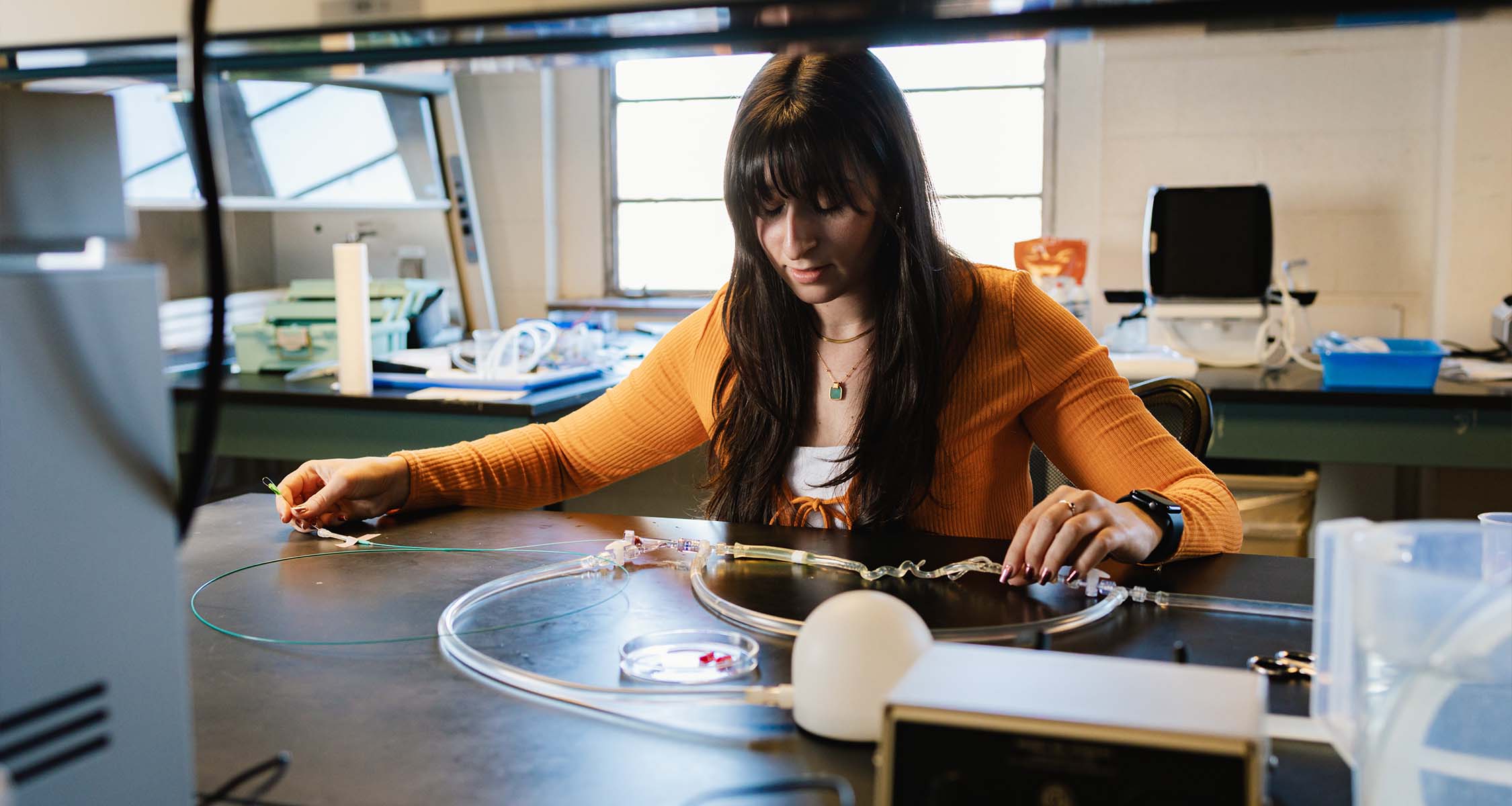
Through a blend of rigorous coursework, hands-on lab experience, and interdisciplinary research, students gain a deep understanding of how engineering principles can be applied to biological systems. From the classroom to the SynDaver Lab, UT’s biomedical engineering majors learn to think critically, solve real-world problems, and design systems that directly impact human health.
Our biomedical engineering undergraduate degree program is accredited by ABET. Learn more about our accreditation.

Why Study Biomedical Engineering?
Biomedical Engineering is a fast-growing, interdisciplinary field where innovation meets human health. Biomedical engineers design technologies like prosthetics, imaging systems, and wearable devices that improve lives. Our program prepares students for this future by fostering creativity, technical skills, and leadership—all within a curriculum that blends engineering with life sciences. Graduates are equipped for impactful, high-demand careers across healthcare, research, and industry.
Minor
In addition to a BS program, our department offers a minor in biomedical engineering.
Five-Year BS/MS
The five-year BS/MS program offers an efficient path for students to earn both undergraduate and graduate degrees in biomedical engineering. By beginning graduate coursework during their senior year, students can accelerate their education and deepen their expertise—preparing for advanced roles in industry or continued study.
Our Curriculum
The biomedical engineering undergraduate curriculum provides a strong foundation in engineering, mathematics, and life sciences, combined with specialized biomedical courses to prepare students for careers in healthcare, medical device design, and research.
Core Coursework Includes:
- Calculus, differential equations, and linear algebra
- Physics and chemistry fundamentals
- Biology and physiology essential for biomedical applications
- Core engineering principles: statics, dynamics, circuits, and materials science
- Biomedical-specific courses including two senior design capstone courses.
- Laboratory and design experiences integrated throughout the program
Degree Requirements:
- Approximately 132 credit hours total
- Foundational courses in math, physics, chemistry, and biology in the first two years
- Upper-division biomedical engineering courses focused on diagnostics, therapeutics, medical device design, and pre-medical studies
- Senior capstone design project spanning two semesters to develop practical problem-solving and teamwork skills
The curriculum is designed to balance theory and application, ensuring graduates are prepared for immediate employment or advanced graduate study.
Check out the course catalog for more information.
Featured Courses
Check out some of the courses that our students take as part of the biomedical engineering program. For a full list of courses, use the link below.
BME 345 Instrumentation
Fundamentals of measurement systems. Standards, dynamic characteristics of instruments, and statistical data treatment. Transducers, signal conditioning, strain, pressure, and temperature and flow measurements.
BME 363 System Dynamics
Free and forced vibrations of damped and undamped lumped parameter systems. Transient and frequency response of lumped parameter systems. Introduction to feedback control systems.
BME 450 Biomedical Engineering Design
Design of biomedical systems. Economics, optimization, reliability, patents, and product liability. Participation in team design efforts. Requires oral and written design reports.
BME 473 Biomechanics
Applications of biomechanics to the industrial and orthopedic area. Design of orthopedic implant devices; biomechanics of injury and protection.

Join Us on Rocky Top
Apply to UT
Interested in learning more about becoming an Engineering Vol? Want to learn about the college’s admission requirements for new students? Use the links below to learn more about how to join our Volunteer community!