
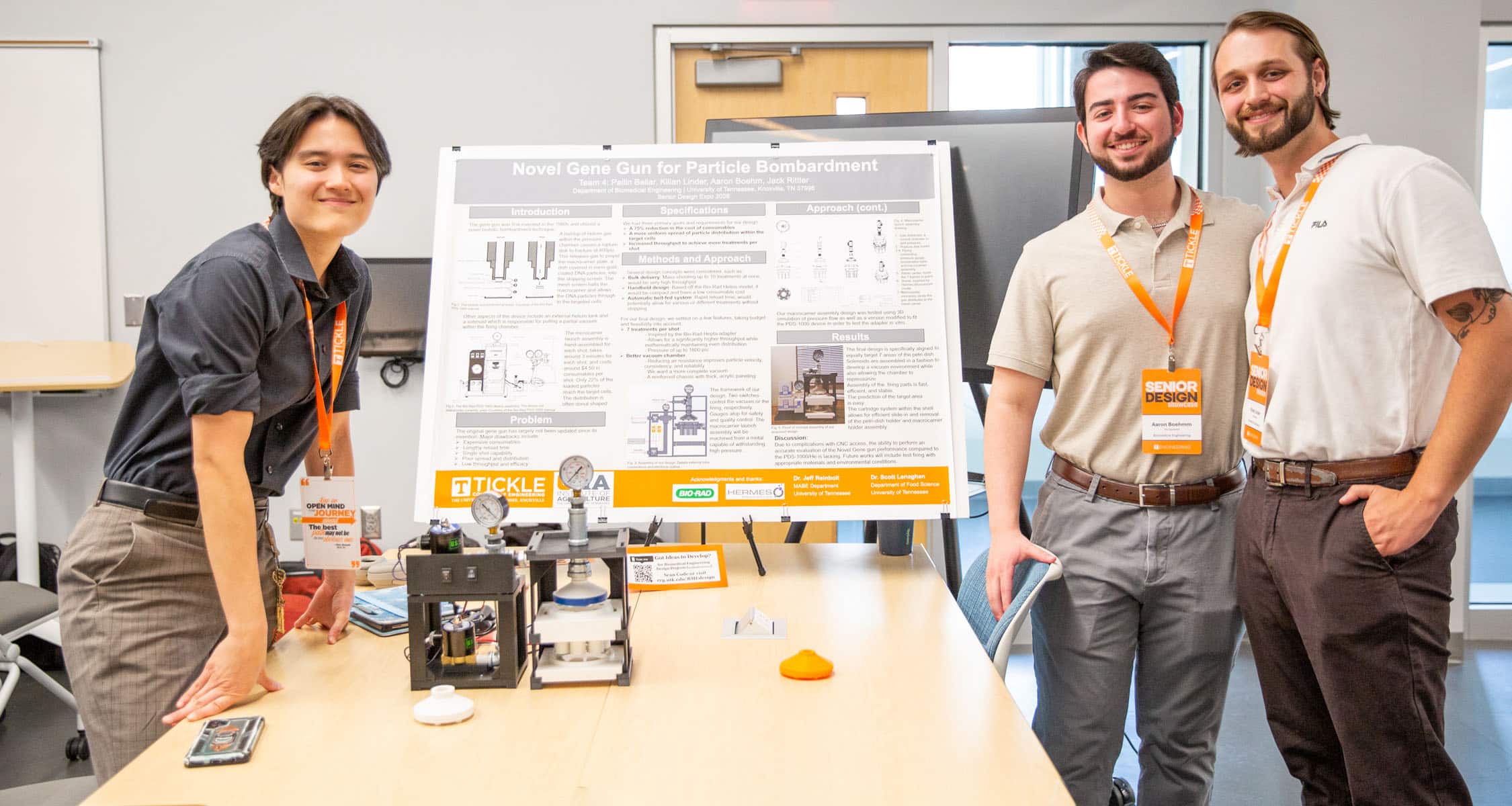
Senior Design Team Invents a Better Gene Gun
With climate change threatening global food supplies and the human population continuing to grow, food production is a major research concern. One problem is that photosynthesis is extremely inefficient; even staple plants with high-calorie products, like potatoes, harness less than one percent of sunlight in the best conditions.
Scott Lenaghan, a professor in the University of Tennessee Institute of Agriculture and a co-director of the Center for Agricultural Synthetic Biology (CASB), is working to supercharge food production by increasing that efficiency. His lab is developing a synthetic genome (package of many genes) that encodes boosted photosynthetic proteins.
To test each upgraded gene, Lenaghan has to put them into potato cells and make sure the transformed (modified) plants function as predicted. His lab does this with a gene gun, a piece of equipment patented in the 1980s that uses pressurized helium to launch many copies of a gene into living cells.
“Without the gene gun, it would not be possible to engineer any plant chloroplasts,” Lenaghan said. “In fact, many elite varieties of crops can only be (created) using the gene gun.”
However, the 40-year-old industry standard design is showing its age—and its drawbacks. The full assembly costs about $30,000, with each shot requiring an additional $4 in helium and other consumables. Setting up a single transformation shot takes three minutes, so performing the large number of transformations needed often takes Lenaghan’s staff more than 10 hours. The gene ‘bullets’ are also blasted unevenly, making it hard to predict which cells will actually receive the treatment.
When the gene gun came off patent in 2025, Lenaghan proposed improving the gene gun as a project for a Department of Biomedical Engineering (BME) senior design team to tackle.
“The BME senior design program is the last academic bridge between theory-based education and a problem-solving profession,” said BME Associate Professor and senior design advisor Jeff Reinbolt. “Our students experience open-ended biomedical design projects where they consider many different potential designs and manufacture the one that functionally meets their customer’s needs.”
Pailin Beller, Aaron Boehm, Kilian Linder, and Jack Rittler (all BS/BME, ’26) knew that upgrading an industry standard was a tall order, but that’s just what they had been looking for.
“One of my personal goals when I entered UT was to get the most out of my education, so I wanted to tackle something ambitious for senior design,” Beller said. “We wanted to be one of the first teams to make these efficiency improvements (to the gene gun) and kind of set the gold standard for efficiency.”
The students’ success speaks for itself. Their new assembly costs less than $1,000 to make and can ‘fire’ seven gene treatments at once.
“By firing seven controlled shots instead of one random shot, my team will be able to push the frontier of plant bioengineering further and focus on solutions to critical problems affecting us all,” Lenaghan said. “Further, the reduction in cost will increase the potential for smaller labs to engage in chloroplast engineering.”
Designing the New Gene Gun
When they first inspected the gene gun in Lenaghan’s lab, the students believed that adjusting the helium chamber would be enough to improve throughput. In the end, they created an entirely new device.
“It turned into a multi-system design featuring electronics, gas movement, and vacuum containment,” Beller said. “We were creating this entire thing from scratch, essentially, and it was very challenging at first.”
In addition to referencing the patented 1980s design, Beller, Boehm, Linder, and Rittler found inspiration from much further back. British nock guns—firearms used in the Napoleonic wars—used a single gunpowder chamber to fire seven bullets. The students realized that they could use the same type of design to evenly fire seven gene treatments at a plate of cells at once.
To present their work at their Senior Design Showcase this spring, the alumni 3D-printed their design in PLA plastic, testing it using baby powder instead of genetic material.
“Even with this 3D-printed model, we were able to get seven pretty even individual spreads of gas flow,” Boehm said. “It was really awesome—and kind of surprising, because even when your simulations say (something will) work, you don’t expect it to work in real life the first time.”
The BME senior design class voted the gene gun as the Best Overall Project at the Senior Design Showcase in recognition of the time and effort Beller, Boehm, Linder, and Rittler put into their design. Lenaghan also hired the team over the summer of 2026, giving them time to create a sterilizable aluminum prototype that will be finished at the UT machining lab.
“These researchers are trying to improve crop yield and health,” Linder said. “These are noble causes that need to be researched, so the ability to help those people do that work is quite rewarding.”
Contact
Izzie Gall ([email protected])