
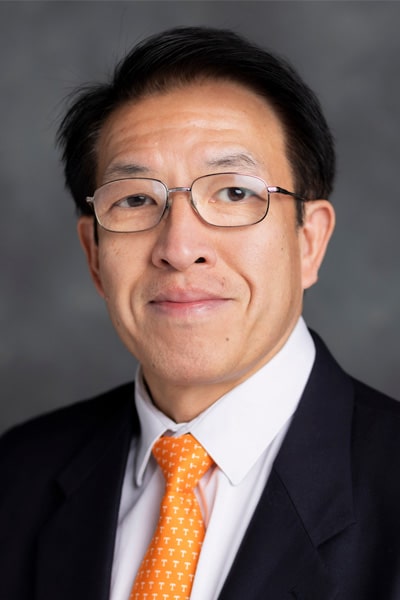
Dacheng Ren
Zeanah Professor and Department Head
Contact Information
301 Perkins Hall
Phone
865-974-0679
Email
[email protected]
Website
beat.labs.utk.edu
Biography
Ren earned his BE in applied chemistry and electrical engineering from the Shanghai Jiao Tong University in 1996. He earned his Master of Engineering in chemical engineering from Tianjin University, China in 1999. Ren came to the United States in 1999 as a graduate student at the University of Connecticut. Upon completing his PhD in 2003, Ren worked as a postdoctoral associate in the chemical engineering department at Cornell University.
In 2006, Ren began his career as professor of biomedical engineering at Syracuse University. He was awarded tenure in May 2011 and became a full professor in May 2016. Ren has published over 100 papers and books on biofilm related topics and holds 11 U.S. patents.
2025-Present
Zeanah Professor and Department Head, Department of Biomedical Engineering, University of Tennessee, Knoxville
2020-2025
Associate Dean for Research, College of Engineering and Computer Science, Syracuse University
2017-2025
Stevenson Endowed Professor, Department of Biomedical and Chemical Engineering, Syracuse University
2016-2020
Director, Syracuse Biomaterials Institute, Syracuse University
2016-2025
Professor, Department of Biomedical and Chemical Engineering, Syracuse University
2012-2016
Associate Professor, Department of Biomedical and Chemical Engineering, Syracuse University
2011-2018
Director of Chemical Engineering Graduate Program, Department of Biomedical and Chemical Engineering, Syracuse University
2006-2012
Assistant Professor, Department of Biomedical and Chemical Engineering, Syracuse University
2003-2006
Postdoctoral Associate, Department of Chemical and Biomolecular Engineering, Cornell University
Education
- PhD 2003, Chemical Engineering, University of Connecticut
- MS 1999, Chemical Engineering, Tianjin University, China
- BE 1996, Applied Chemistry, Shanghai JiaoTong University, China
Research
Historically, our understanding of bacterial physiology and development of antibiotics have been focused on active planktonic (free-swimming) cells. However, the vast majority of bacteria in nature and medical environments exist in surface-attached biofilms with varying levels of dormancy. With up to 1,000 times higher tolerance to antibiotics and disinfectants compared to their planktonic counterparts, deleterious biofilms cause serious problems such as chronic infections in humans as well as persistent fouling and equipment failure in industry. Biofilms are blamed for billions of dollars of losses and more than 45,000 deaths annually in the U.S. alone. Despite the well-recognized significance of biofilms, the mechanisms of biofilm formation and bacterial dormancy are still not fully understood with many fundamental questions unanswered. Controlling biofilms and dormant cells is also challenging. To address these challenges, we conduct both basic and translational research with specific interests in bacteria-material interactions, novel antifouling materials, new agents for controlling biofilms and dormant cells, synthetic biology for microbial control, and smart and safer medical devices.
Areas of Expertise
- Biomaterials
- Medical devices
- Biotechnology
- Synthetic Biology
- Bacterial control
Professional Service
- AIMBE Fellow
- Editorial Board of Elsevier’s Biofilm journals
Awards and Recognition
- Fellow, American Institute for Medical and Biological Engineering (AIMBE), 2022
- Chancellor’s citation for Faculty Excellence & Scholarly Distinction, Syracuse University, 2018
- Faculty Excellence Award, School of Engineering & Computer Science, Syracuse University, 2014
- NSF CAREER Award, 2011-2016
- College Technology Educator of the Year by the Technology Alliance of Central New York (TACNY), 2010.
- Early Career Translational Research Award in Biomedical Engineering, Wallace H. Coulter Foundation, 2009
Publications
For a complete list of recent publications, see Google Scholar.
- Yikang Xu and Dacheng Ren. “A novel inductively coupled capacitor wireless sensor system for rapid antibiotic susceptibility testing.” Journal of Biological Engineering. 17, Article number: 54 (2023).
- 72. Sang Won Lee, Erick L. Johnson, J. Alex Chediak, Hainsworth Shin, Yi Wang, K. Scott Phillips and Dacheng Ren. “High-Throughput Biofilm Assay to Investigate Bacterial Interactions with Surface Topographies.” ACS Applied Bio Materials. 5: 3816-3825 (2022).
- Sweta Roy, Ali Adem Bahar, Huan Gu, Shikha Nangia, Karin Sauer and Dacheng Ren. “Persister Control by Leveraging Dormancy Associated Reduction of Antibiotic Efflux.” PLOS Pathogens. 17(12): e1010144 (2021).
- Sang Won Lee, Joseph Carnicelli, Dariya Getya, Ivan Gitsov, K. Scott Phillips and Dacheng Ren. “Biofilm Removal by Reversible Shape Recovery of the Substrate.” ACS Applied Materials & Interfaces. 13 (15): 17174–17182 (2021)
- Sang Won Lee, K. Scott Phillips, Huan Gu, Mehdi Kazemzadeh-Narbat, Dacheng Ren. “How microbes read the map: effects of implant topography on bacterial adhesion and biofilm formation.” Biomaterials. 268: 120595 (2021).
- Huan Gu, Sang Won Lee, Joseph Carnicelli, Teng Zhang, and Dacheng Ren. “Magnetically driven active topography for long-term biofilm control”. Nature Communications. 11: Article number: 2211 (2020).
- Yikang Xu, Yousr Dhaouadi, Paul Stoodley, and Dacheng Ren, “Sensing the unreachable: challenges and opportunities in biofilm detection”. Current Opinion in Biotechnology. 64: 79-84 (2020).
For a full list of publications, please visit his Google Scholar profile.