
Graduate programs
PhD in Biomedical Engineering
The PhD program in biomedical engineering at UT is designed to develop the next generation of experts, leaders, and researchers equipped to push the boundaries of biomedical science and technology. Graduates emerge ready to lead in academia, industry, and clinical innovation.
Program Overview
PhD students complete advanced coursework, pass comprehensive examinations, and carry out independent research, culminating in a dissertation. Engagement includes seminars, proposal defenses, and dissertation defense before an advisory committee. Students can specialize in fields like biomechanics, robotics, theranostics, materials, or, via CIRE, Energy Science and Engineering.
Why Study at UT?
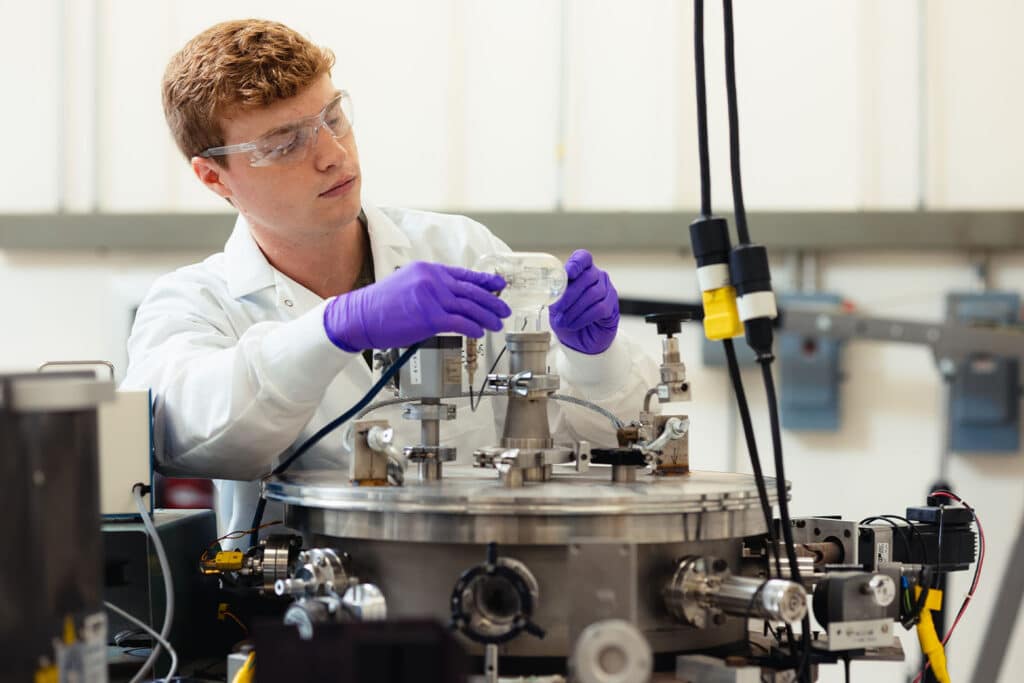
Our PhD program offers unmatched depth in research and innovation. You’ll work alongside distinguished faculty and leverage cutting-edge labs plus collaborations with UT Medical Center and ORNL. Graduates are positioned for leadership in academia, research institutions, healthcare industries, and beyond.
Nationally Recognized
Our biomedical engineering graduate program is ranked as the 49th best public graduate program in the nation, according to U.S. News and World Report.
Facilities and Partnerships
Our department collaborates with the UT Medical Center, Graduate School of Medicine, College of Veterinary Science, ORNL, and other engineering departments for a more robust academic experience. In addition, students have access to top-quality studios for design, manufacturing, and testing biomedical devices.

Our Curriculum
The PhD program requires a minimum of 72 credit hours beyond the bachelor’s degree. These must include a minimum of 24 hours in Doctoral Research and Dissertation (BME 600). Specific requirements for required course work are:
Coursework:
- With a BS Degree: Students will be required to take a minimum 42 hours of graduate courses, exclusive of BME 600, dissertation credit, or seminar courses.
- With a MS Degree: Students will be required to take a minimum 12 hours of graduate courses, exclusive of BME 600, dissertation credit, or seminar courses.
Specific Requirements:
- At least 9 credit hours in graduate-level mathematics, including 3 at the 500‑level.
- Minimum 21 credit hours in BME coursework at the 500‑level or above.
- At least 6 credit hours of 600‑level coursework, exclusive of research credits
Additional Milestones:
- Graduate seminar attendance (BME 595)
- Written and oral comprehensive exams
- Dissertation proposal presentation and successful defense
Concentrations
Additionally, students can pursue concentrations in several areas including biomechanics, materials, nuclear space science and engineering, robotics, and theranostics.
Check out the course catalog for more information.
Featured Courses
Check out some of the courses that our students take as part of the biomedical engineering program. For a full list of courses, use the link below.
BME 530 Thin Film Enhancement of Biomedical Devices
Techniques for depositing thin films and the instruments used will be introduced with focus on biomaterial applications. Topics include film growth on implant surfaces, structural tailoring, and evaluation of uniformity, adhesion, cytotoxicity, and bacterial resistance. Course will also explore thin film use in tissue engineering and stem cell technologies, with discussion on biological interfaces and biocompatibility.
BME 605 Artificial Organs
Current artificial organs include Heart, Liver, Kidney, Lung, Pancreas, Skin, Bladder, Auditory brainstem, Bionic contact lens, Cochlear implant and Retinal implant. Course will cover a different organ each week with student led discussions after an introduction of required foundational information.
BME 632 Advanced Biomechanics II
Using the symbolic manipulation algorithm, difficult systems pertaining to the human body will be modeled. A more in-depth analysis of Kane’s method of multibody dynamics will also be implemented in these models. Each student will focus on one complex model that pertains to an orthopedic complication that the orthopedic industry needs solved.
BME 678 Magnetic Nanoparticles
Magnetic nanoparticles have a wide and varied use in medicine. They can be used in magnetic separation, molecular carriers for gene separation, drug delivery or drug carriers, and hyperthermia treatment and as an enhancer for magnetic resonance imaging. The course addresses synthesis, properties and characterization of the nanoparticles as well as optional functionalization and applications, in particular pertaining to cancer therapy, toxin removal, imaging, lab-on-a-chip and thrombosis.

Join Us on Rocky Top
Apply to Grad School
Ready to become an Engineering Vol? Want to learn about our admission requirements for Grad School? Use the links below to learn more about how to join our Volunteer community!