
West Point cadet James Ross felt right at home at the University of Tennessee, Knoxville (UT) this summer. Not only did Ross know most of the group members he was working with in the Department of Materials Science and Engineering (MSE), but he was also familiar with the research and started right to work.
The experience enabled Ross to make greater contributions in a shorter span of time while interning with MSE Professor Katharine Page’s group for the second straight summer at the Institute for Advanced Materials and Manufacturing (IAMM).
Ross, a Tennessee native, and MSE graduate student Sean Drewry worked this summer to explore compositional ranges of pyrochlore oxides and to see what combinations provide the best thermal conductivity and thermal expansion properties.
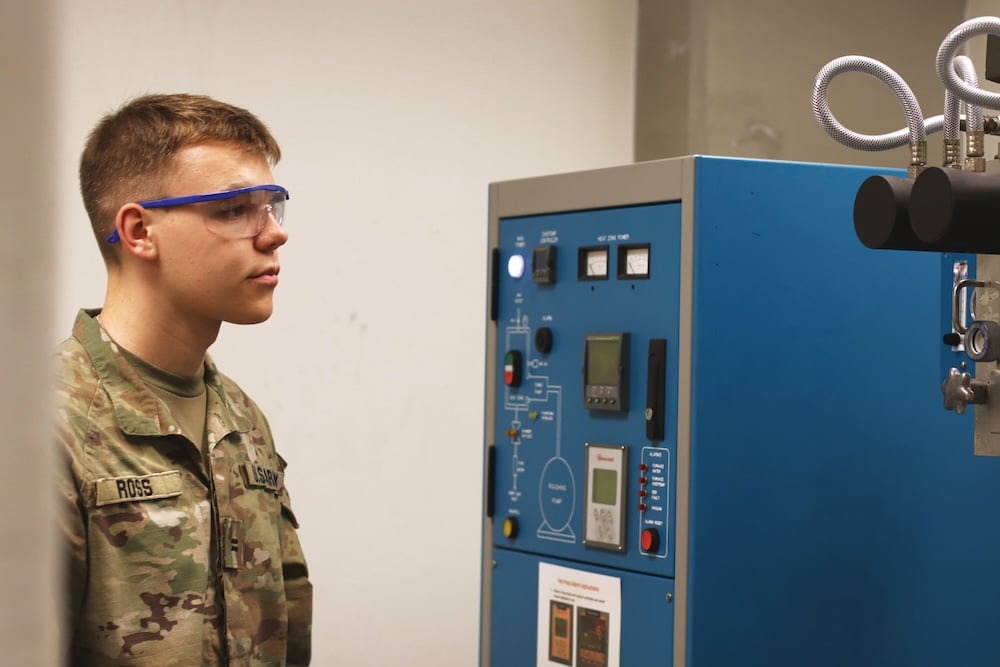
“West Point, at its core, is an engineering school. We’re here to teach and educate our officers for the future, so these academic development opportunities help build a breadth of knowledge,” said Ross, a rising junior chemistry major at the United States Military Academy (USMA) at West Point. “We don’t have a major at West Point in materials and being able to come here and see what’s going on was really interesting to me and something I’d never thought about.”
The opportunity came through the Academic Individual Advanced Development (AIAD) program West Point offers cadets to broaden their experience and help them become more well-rounded leaders by spending time in a world-class immersive learning environment.
The AIAD internship with UT launched two years ago as part of a cooperative agreement between UT and U.S. Army Combat Capabilities Development Command Army Research Laboratory (DEVCOM ARL).
In addition to Ross, West Point cadets Lukas Gacek and Eric Zhu interned with Department of Mechanical and Aerospace Engineering Assistant Professor Damiano Baccarella this summer.
“I think it’s super valuable to have these collaborations with military colleges. James’ leadership and perspective on things was really nice to add to my research group,” Page said. “It’s part of the Army culture and it’s nice for us to be exposed to that and work with their students. It’s a great alignment.”
Leadership and Learning
After last year’s internship at UT, Ross continued to work with his faculty advisor Col. Chi Nguyen on materials characterization of samples that Page’s group sent to them at West Point during the school year. Drewry traveled to West Point’s campus in the fall to attend the ARL-USMA Technical Symposium poster session James presented at, and Nguyen hosted Page for a faculty seminar in the spring.
The group is trying to produce ceramic materials that are good for high-temperature environments. The project supports the Army’s modernization priority in long-range precision fires. The materials could be used for coatings and protective layers that will help objects fly faster, higher, and farther.
“We’re specifically exploring new phase spaces and learning how to test those materials at really high temperatures and other extremes,” Page said. “Sean’s research project is one part developing materials in that space, and two parts performing the testing of those materials and developing tools to test those materials.”
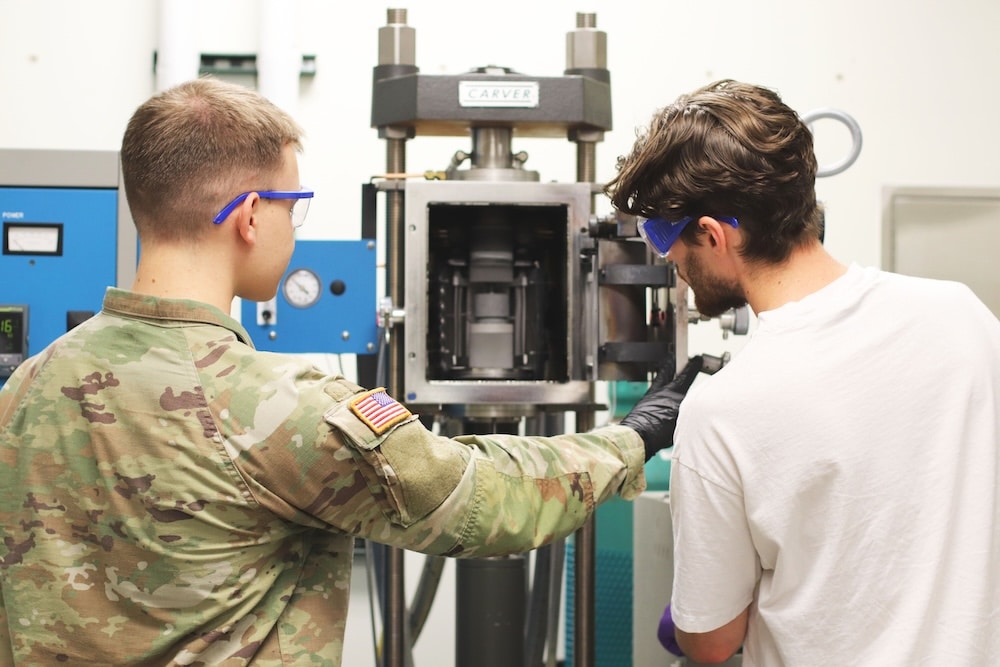
Not everything went according to plan for Ross during his three-week internship. He made a mistake during a synthesis process in the lab and had to restart, losing nearly a week’s worth of work.
“I ended up having to go to Sean and delivering that news and having that difficult conversation,” Ross said. “As somebody who’s going to lead soldiers, being able to say, ‘I screwed up, and we’re going to have to pivot here,’ is an important lesson. Luckily, Sean is a great leader and mentor and was able to react accordingly.”
Drewry viewed the setback as a normal part of the research process that nearly everyone must navigate at some point.
“We may be able to just spin it into a new material composition that we’re interested in,” Drewry said. “It’s a little different of a composition than what we were targeting, but we might still be able to use those materials. So hopefully it’s a happy accident.”
Future Educational Opportunities
Ross will again be presenting a poster of his work at UT this summer at a technical symposium held by ARL.
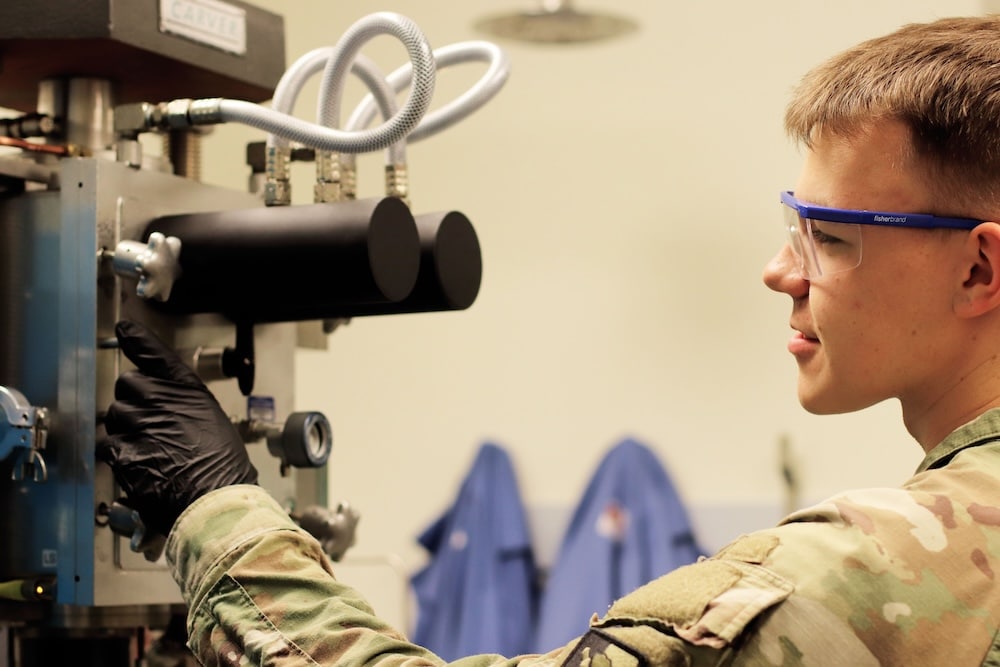
“Our goal was that James would experience and participate in learning about new materials research and some of the materials testing that’s integral to showing they’re good technologies,” Page said. “We recently completed a draft of the paper on the research and James is the second author on that paper. That’s exciting.”
Ross wants to continue to study materials science and eventually obtain his PhD. “A big hope of mine is to one day become permanent faculty at West Point,” Ross said. “I really get a lot out of lecturing and presenting to people and just teaching in general.”
Page would love to have Ross return to UT in the future, whether it’s for another internship or to pursue his PhD studies.
“My clear message is for him to just let us know and we will find a spot,” she said. “He’s always welcome back here as a Vol.”
Contact
Rhiannon Potkey ([email protected])